


RTP volatility bonuses Key Takeaways
If you’ve ever wondered why one promotion seems to vanish from your balance in minutes while another stretches for hours, the answer lies in RTP volatility bonuses .
- RTP (Return to Player) is the theoretical percentage a slot pays back over millions of spins. Promotions with wagering requirements attached to high-RTP slots give you a better expected value.
- Volatility determines how often and how much a slot pays. Bonuses on low-volatility slots stretch your playtime, while high-volatility games can turn a small bonus into a big win — or vanish quickly.
- Bonus math combines RTP, volatility, and wagering terms into a single metric: expected return per dollar wagered. Use this to compare promotions before you click “claim.”
Table of Contents
- What Every Player Should Know About RTP volatility bonuses
- RTP — The Long‑Run Anchor
- Volatility — The Ride You’re In For
- Bonuses — The Terms That Change Everything
- How RTP, Volatility, and Bonuses Work Together Mathematically
- Hypothetical Example: Two Bonuses, One Casino
- The Role of Bonus Structure: Match, Free Spins, and Cashback
- Deposit Match Bonuses
- Free Spins Promotions
- Cashback Offers
- Strategic Tips for Choosing RTP volatility bonuses
- Tip 1: Calculate the Expected Value Before You Claim
- Tip 2: Match Volatility to Your Bankroll
- Tip 3: Check Game Contribution Percentages
- Tip 4: Focus on Low Wagering Requirements
- Useful Resources
- What is the best RTP for a bonus slot?
- Does volatility affect bonus wagering?
- How do I calculate bonus expected value?
- What is a good wagering requirement for online slots?
- Can I use a high-volatility slot to beat a bonus?
- What is the difference between RTP and house edge?
- Do all slots contribute equally to wagering?
- What is a negative EV bonus?
- Is it better to play low or high volatility with a bonus?
- How does cashback affect bonus math?
- What is the average RTP of online slots?
- Do free spins have wagering requirements?
- Which bonus type is mathematically best?
- Can I use bonus math on no-deposit bonuses?
- What is the maximum bet limit during a bonus?
- How does the “bonus only” wagering work?
- What is a sticky bonus?
- Are table games included in slot bonuses?
- Can I combine multiple bonuses to improve EV?
- What is the best online slot for meeting bonus wagering?
What Every Player Should Know About RTP volatility bonuses
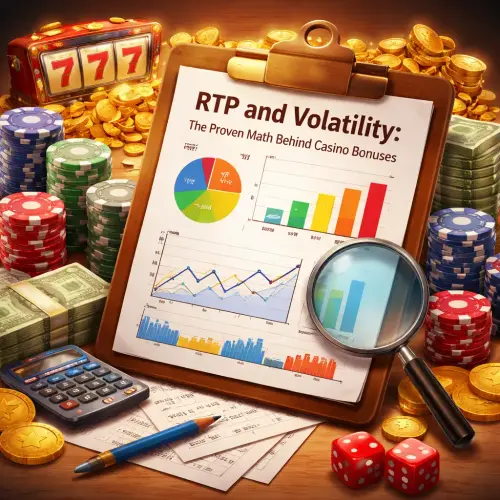
If you’ve ever wondered why one promotion seems to vanish from your balance in minutes while another stretches for hours, the answer lies in RTP volatility bonuses. These three numbers — Return to Player, volatility, and the bonus terms — work together to determine your real expected outcome. Let’s define each one clearly before we show how they combine.
RTP — The Long‑Run Anchor
RTP stands for Return to Player. It’s a theoretical percentage that tells you how much of every dollar wagered a slot is designed to pay back over a very large number of spins. A slot with a 96% RTP will, in theory, return $96 for every $100 bet after millions of spins. No single session follows this exactly, but RTP is your best baseline when evaluating a bonus. Promotions that restrict you to slots with lower RTP (say 92%) immediately cut your expected value — even if the bonus amount looks generous.
Volatility — The Ride You’re In For
Volatility (also called variance) describes the risk profile of a slot. Low-volatility slots pay small wins frequently. High-volatility slots pay less often but offer the chance for much larger payouts. Volatility bonuses matter because a bonus’s wagering requirement interacts differently with each volatility level. A low-vol slot will help you clear wagering steadily, while a high-vol slot might zero out your balance before you meet the playthrough — or deliver a single big win that covers it all. Your choice depends on your bankroll and your tolerance for risk.
Bonuses — The Terms That Change Everything
Online slot promotions come in many shapes: deposit matches, free spins, no-deposit bonuses, cashback offers. But every bonus has a set of terms — wagering requirements (playthrough), maximum bet limits, eligible games, and expiry dates. The real math begins when you combine these terms with the slot’s RTP and volatility. A 100% deposit match with 35x wagering on a 96% RTP low-volatility slot is mathematically very different from the same bonus on a high-volatility 94% RTP slot. For a related guide, see Wagering Requirements Strategy Malaysia: Smart Ways to Clear Casino Bonuses Faster.
How RTP, Volatility, and Bonuses Work Together Mathematically
The core formula for evaluating a bonus is straightforward: expected value (EV) = total expected winnings from playthrough minus the cost of wagering. Let’s walk through a realistic example to see how the three factors combine.
Hypothetical Example: Two Bonuses, One Casino
Imagine you claim a $100 deposit bonus with 30x wagering on the bonus amount only. You have $3,000 in wagering to complete. You pick two different slots:
Slot A: 97% RTP, low volatility
Slot B: 95% RTP, high volatility
For Slot A: Expected loss during wagering = $3,000 × (1 – 0.97) = $90. Your net expected value after the bonus = $100 (bonus) – $90 = +$10. Positive EV! Low volatility means you’ll likely survive the 30x wagering without going broke.
For Slot B: Expected loss during wagering = $3,000 × (1 – 0.95) = $150. Net EV = $100 – $150 = -$50. Negative EV. The high volatility adds variance — you could lose your entire deposit before reaching the wagering requirement, or you could hit a big win early. The math says you’re more likely to lose money on average.
This example shows why RTP volatility bonuses must be analyzed together. A high RTP slot paired with low volatility tends to give you the best expected return for meeting wagering — assuming the bonus terms are the same.
The Role of Bonus Structure: Match, Free Spins, and Cashback
Not all bonuses treat RTP and volatility the same way. Here’s how the math shifts with different promotion types.
Deposit Match Bonuses
These are the most common. The match percentage (e.g., 100% up to $200) and wagering requirement (e.g., 35x) set the baseline. Your optimal strategy is to choose a slot with the highest RTP that also qualifies for the bonus. Avoid slots that contribute less than 100% to wagering (some casinos cap game contributions for table games or certain high-RTP slots). Stick to low-volatility slots if you want to preserve your bankroll and complete wagering steadily. For a related guide, see Best Games for Casino Bonus Wagering Malaysia: Smart Game Choices to Clear Bonuses Faster.
Free Spins Promotions
Free spins usually come with a fixed value per spin and a wagering requirement on winnings. The RTP of the slot determines how much each free spin is worth on average. For example, 50 free spins on a 96% RTP slot at $0.10 per spin gives you an expected value of 50 × $0.10 × 0.96 = $4.80 in winnings (before wagering). If wagering on those winnings is 40x, your final EV shrinks further. High-volatility free spins can produce a larger prize but also a higher chance of winning nothing after wagering.
Cashback Offers
Cashback bonuses are the safest mathematically because they reduce your downside. A 10% cashback on net losses with no wagering requirement is essentially a 10% reduction in the house edge. For high-volatility play, cashback can be a lifesaver — it softens the inevitable dry spells. Combined with a high-RTP slot, cashback offers can push your overall EV very close to break-even or slightly positive.
Strategic Tips for Choosing RTP volatility bonuses
Here are actionable tips to apply the math behind promotions when you’re ready to play.
Tip 1: Calculate the Expected Value Before You Claim
Use a simple EV calculator. You need three numbers: bonus amount, wagering requirement, and the RTP of your chosen slot. The formula is: EV = bonus – (wagering × (1 – RTP)). If the result is positive, the bonus has value. If negative, it’s a bad deal — skip it.
Tip 2: Match Volatility to Your Bankroll
Low bankroll? Stick with low-volatility slots and low wagering requirements. High bankroll with a tolerance for risk? High-volatility slots can turn a small bonus into a massive payout — but only if you’re prepared for the possibility of losing it all. Use cashback offers to hedge your high-volatility bets.
Tip 3: Check Game Contribution Percentages
Some casinos cap the contribution of high-RTP slots (e.g., only 50% of your bets count toward wagering). Always read the terms. A slot with 98% RTP that only contributes 50% may actually be worse than a 96% RTP slot that contributes 100%. This is a common trap that ruins the bonus math strategy of even savvy players.
Tip 4: Focus on Low Wagering Requirements
Wagering requirements of 20x or lower are generally more favorable. Above 40x, the EV turns negative for most slots unless the RTP is exceptionally high and the volatility is very low. Avoid bonuses with wagering above 50x unless you enjoy gambling with zero expected return.
| Factor | Favorable Condition | Unfavorable Condition |
|---|---|---|
| RTP | 96% or higher | Below 94% |
| Volatility | Low to medium for wagering | Very high without cashback |
| Wagering Requirement | 20x or lower | Above 50x |
| Max Bet Limit | Above $5 per spin | $1 or less |
Useful Resources
For deeper reading on the mathematics of casino promotions, check out these credible sources:
- AskGamblers Guide to Casino Bonus Terms — A practical breakdown of wagering requirements, game contributions, and how to read the fine print.
- CasinoMeister Bonus Math Explained — A detailed look at expected value calculations and how RTP interacts with different bonus structures.
Frequently Asked Questions About RTP volatility bonuses
What is the best RTP for a bonus slot?
Generally, 96% or higher gives you the best chance to complete wagering with a positive expected value. Slots above 98% RTP exist but are rare and sometimes restricted by casino bonus terms.
Does volatility affect bonus wagering?
Yes. Low-volatility slots help you meet wagering requirements steadily with smaller, frequent wins. High-volatility slots can drain your balance quickly or produce one big win that covers the requirement — but the risk is much higher.
How do I calculate bonus expected value?
Use the formula: EV = bonus amount – (total wagering requirement × (1 – RTP)). If the result is positive, the bonus is mathematically favorable in the long run.
What is a good wagering requirement for online slots?
20x or lower is considered good. At 30x, you need a high-RTP slot to break even. Above 50x, the bonus is almost always negative EV unless slot contributions are 100% and RTP is very high.
Can I use a high-volatility slot to beat a bonus?
You can, but it’s a high-risk strategy. If you hit a big win early, you can complete wagering with a profit. If not, you lose your deposit. This is gambling, not math-based value.
What is the difference between RTP and house edge?
RTP is the percentage returned to players. The house edge is 100% minus RTP. For example, a 96% RTP slot has a 4% house edge. Both measure the same thing from opposite sides.
Do all slots contribute equally to wagering?
No. Many casinos cap contributions for high-RTP slots or table games. Always check the bonus terms for “game contribution percentages” — a slot that contributes 100% is usually better than one with 50% contribution even if its RTP is slightly lower.
What is a negative EV bonus?
A negative expected value bonus means the mathematical loss from wagering exceeds the bonus amount. You are statistically better off not claiming it and playing without a bonus instead.
Is it better to play low or high volatility with a bonus?
If your goal is to complete wagering with minimal risk, low volatility is better. If you want a shot at a large win and can afford to lose the deposit, high volatility may be worth the gamble. It depends on your bankroll and risk tolerance.
How does cashback affect bonus math?
Cashback reduces your downside risk, effectively lowering the house edge for that session. It makes high-volatility play more viable because you recoup some losses. Cashback with no wagering is the most valuable.
What is the average RTP of online slots?
Most online slots range from 94% to 97% RTP. The industry average is around 96%. Some providers offer slots as high as 99%, but they usually have lower maximum bet limits or are restricted on bonuses.
Do free spins have wagering requirements?
Yes, almost always. Winnings from free spins are subject to wagering requirements. The RTP of the free spin slot determines the average value of each spin before wagering.
Which bonus type is mathematically best?
Cashback offers with no wagering are mathematically best because they reduce the house edge without adding playthrough. After that, low wagering deposit bonuses (20x or less) on high-RTP low-volatility slots offer the best EV.
Can I use bonus math on no-deposit bonuses?
Yes. No-deposit bonuses often have high wagering requirements (50x or more). Calculate EV using the same formula: expected winnings minus expected loss from wagering. Most no-deposit bonuses are negative EV, but they offer free play.
What is the maximum bet limit during a bonus?
Casinos set a maximum bet when using bonus funds — often $5 or €5 per spin. Exceeding it voids the bonus. Low max bets can make high-volatility wagering nearly impossible because you cannot bet enough to recover variance quickly.
How does the “bonus only” wagering work?
With “bonus only” wagering, you only need to roll over the bonus amount, not the deposit. For example, a $100 bonus with 30x wagering means you must wager $3,000. This is more favorable than “deposit + bonus” wagering which multiplies the total.
What is a sticky bonus?
A sticky bonus cannot be withdrawn — only winnings from it can be cashed out after wagering. The bonus amount is deducted from your balance when you withdraw. Sticky bonuses can still have positive EV if the wagering terms are low and the slot RTP is high.
Are table games included in slot bonuses?
Rarely. Most slot bonuses exclude table games or give them very low contribution (e.g., 10%). Stick to slots if you want full wagering credit. If you prefer table games, look for dedicated table game promotions.
Can I combine multiple bonuses to improve EV?
Some casinos allow stacking, but terms usually forbid it. You can only have one active bonus at a time. Trying to combine bonuses often results in voiding promotions. Focus on one mathematically sound offer at a time.
What is the best online slot for meeting bonus wagering?
Look for slots with RTP 96%+, low to medium volatility, and 100% contribution to wagering. Popular examples include Starburst (96.1% RTP, low volatility) and Blood Suckers (98% RTP, low volatility). Always confirm with the casino’s terms.